
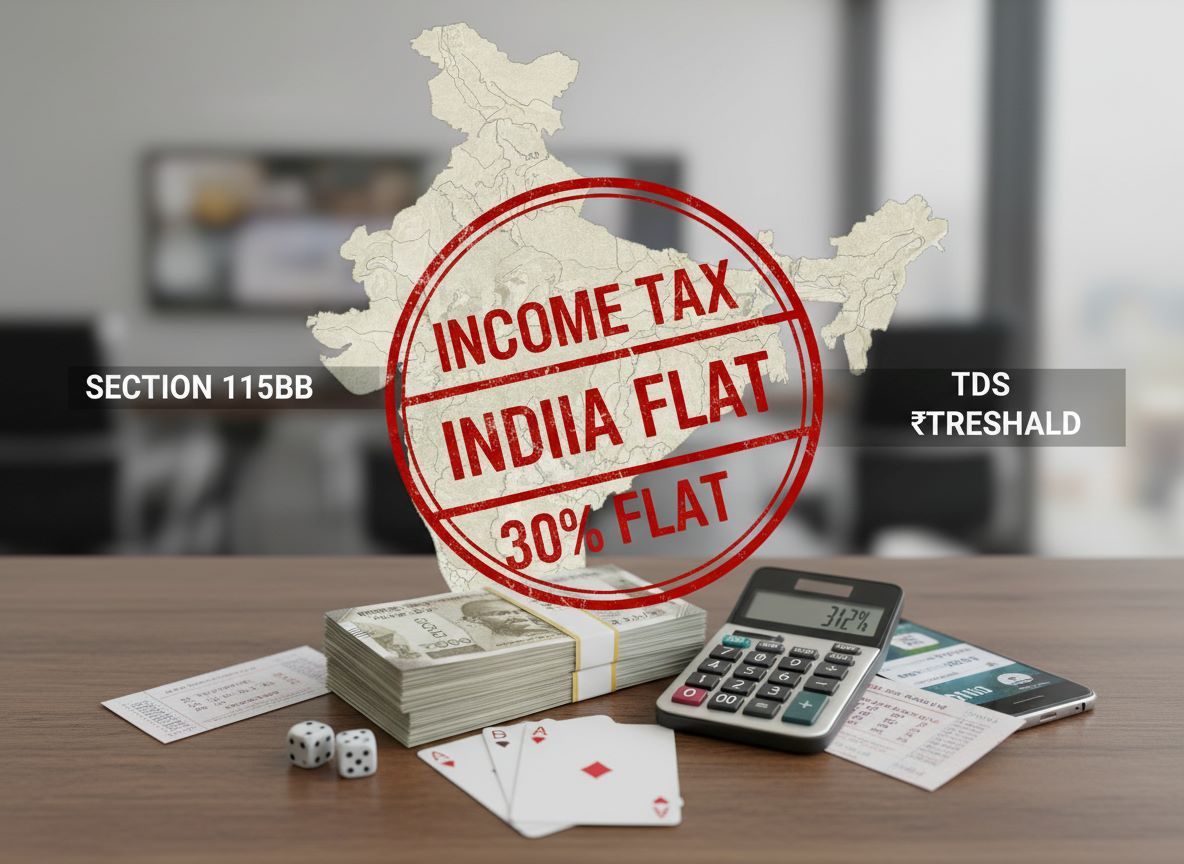
Gambling winnings in India are subject to a stringent tax regime under Section 115BB of the Income Tax Act. This provision imposes a flat 30% tax rate on all gambling winnings, regardless of the amount won or the taxpayer’s income slab. The tax applies to both online and offline gambling activities, including casinos, poker, lotteries, and sports betting, with no deductions allowed for losses or expenses incurred.
The effective tax rate can reach up to 31.2% when surcharge and cess are included for high-income earners. Additionally, Tax Deducted at Source (TDS) is applicable at a threshold of ₹10,000 per event, and all winnings are classified as ‘Income from Other Sources’ for tax reporting purposes. Understanding these rules is crucial for Indian residents engaging in any form of gambling to ensure compliance and avoid penalties.
What is Section 115BB and How Does it Tax Gambling Winnings?
Section 115BB of the Income Tax Act establishes a special taxation regime specifically for gambling winnings, imposing a flat 30% tax rate on all gambling income. This section was introduced to create a uniform tax structure for gambling activities and prevent tax avoidance through complex deduction claims. Unlike regular income that follows progressive tax slabs, gambling winnings are taxed at this fixed rate regardless of the taxpayer’s total income or tax bracket.
The law treats gambling winnings as a separate category of income with no provision for expense deductions, loss offsetting, or depreciation claims. This means that even if a gambler incurs significant losses throughout the year, they must still pay the full 30% tax on any individual winning amount. When surcharge and cess are factored in, the effective rate can increase substantially, making it one of the highest tax rates applicable to any form of income in India.
The taxation under Section 115BB applies from the first rupee won, with no minimum threshold for tax liability. However, TDS is deducted only when winnings from a single event exceed ₹10,000, creating a distinction between tax liability and withholding requirements.
Types of Gambling Covered Under 115BB
- Online casino games including slots, roulette, blackjack, and baccarat
- Poker tournaments and cash games, both online and offline
- Lottery tickets and prize draws, including state and private lotteries
- Sports betting and fantasy sports winnings
- Horse racing betting and other race betting activities
- Card games played for money in clubs or casinos
- Any game of chance or skill played for monetary consideration
No Minimum Winnings Threshold
Unlike many other tax provisions that have minimum thresholds, Section 115BB applies to gambling winnings of any amount. Even a ₹100 win from a lottery ticket or a small poker game is technically subject to the 30% tax rate. This comprehensive coverage ensures that all gambling income is captured under the tax net, regardless of its size.
The absence of a minimum threshold reflects the government’s intent to discourage gambling activities through taxation while ensuring that no gambling income escapes tax liability. This approach differs significantly from other income sources where basic exemption limits apply.
TDS on Gambling Winnings: Deduction Rules
| Winnings Amount | TDS Rate | Deducted By | Applies To |
|---|---|---|---|
| Up to ₹9,999 | No TDS | Not Applicable | All gambling activities |
| ₹10,000 and above | 30% | Platform/Casino/Operator | Online and offline winnings |
| Cross-border winnings | 30% | Indian resident (self) | Foreign casino/platform wins |
| Lottery prizes | 30% | Lottery organizing body | State and private lotteries |
| Tournament prizes | 30% | Tournament organizer | Poker, fantasy sports contests |
TDS on gambling winnings creates an immediate tax collection mechanism that ensures the government receives tax revenue upfront. The ₹10,000 threshold applies per event or transaction, meaning multiple smaller winnings below this limit will not trigger TDS, even if the total exceeds ₹10,000 in a day.
TDS Credit and Excess Liability
When TDS is deducted from gambling winnings, taxpayers can claim this as a credit against their total tax liability when filing their income tax return. If the TDS amount exceeds the actual tax liability, the excess can be claimed as a refund. However, if the total tax liability is higher than the TDS deducted, the taxpayer must pay the balance amount.
Form 16A serves as proof of TDS deduction and must be obtained from the deducting party. This certificate is essential for claiming TDS credit and should be carefully preserved for tax filing purposes. Online platforms typically provide digital certificates, while offline establishments may issue physical certificates.
No Deductions or Losses Allowed Against Winnings
One of the most stringent aspects of gambling taxation under Section 115BB is the complete prohibition of any deductions or loss offsetting against winnings. This means that gambling losses cannot be set off against gambling winnings, expenses incurred for gambling activities cannot be claimed as deductions, and no depreciation can be claimed on equipment used for gambling purposes.
The law requires taxation on gross winnings without any adjustment for losses, making it particularly harsh for recreational gamblers who may have net losses over the year but occasional wins. This approach differs significantly from business income taxation, where expenses and losses are generally allowable deductions.
The prohibition extends to all types of expenses, including travel costs to casinos, entry fees for tournaments, subscription costs for gambling platforms, and even professional gambling coaching fees. These restrictions ensure that the government collects the maximum possible tax revenue from gambling activities while discouraging excessive gambling through the tax burden.
Why Losses Don’t Count
- Legal framework treats each winning event as a separate taxable incident
- Prevents complex loss calculation schemes that could reduce tax liability
- Simplifies tax administration by avoiding detailed expense verification
- Discourages gambling by ensuring consistent tax burden regardless of overall performance
- Eliminates potential tax avoidance through artificial loss creation
- Maintains revenue certainty for the government from gambling taxation
Impact on Net Gamblers
For gamblers who have net losses over the year but occasional wins, the tax system can be particularly burdensome. They must pay 30% tax on each winning event, even if their overall gambling activity results in a loss. This creates a situation where taxpayers may owe significant taxes despite being net losers, making careful record-keeping and tax planning essential for anyone engaged in regular gambling activities.
Effective Tax Rate: Surcharge and Cess Explained
| Winnings Slab | Base Tax | Surcharge | Cess | Effective Rate |
|---|---|---|---|---|
| Up to ₹50 lakhs | 30% | Nil | 4% | 31.2% |
| ₹50 lakhs to ₹1 crore | 30% | 10% | 4% | 34.32% |
| ₹1 crore to ₹2 crores | 30% | 15% | 4% | 35.88% |
| ₹2 crores to ₹5 crores | 30% | 25% | 4% | 40.56% |
| Above ₹5 crores | 30% | 37% | 4% | 42.74% |
The effective tax rate on gambling winnings increases significantly when surcharge and cess are applied to the base rate of 30%. Health and Education Cess at 4% is applicable on the tax plus surcharge amount, while surcharge rates vary based on the total income of the taxpayer, not just the gambling winnings.
No Slab Rate Benefits
Unlike regular income that benefits from progressive tax slabs starting from 5% and reaching 30% only for high earners, gambling winnings are taxed at a flat 30% from the first rupee. This means that even taxpayers in lower income brackets who would normally pay 5% or 20% tax on their regular income will pay 30% plus applicable surcharge and cess on any gambling winnings.
The fixed rate structure eliminates any benefit from income splitting or timing of winnings, making gambling taxation straightforward but expensive. This approach ensures uniform tax treatment regardless of the taxpayer’s financial situation or other income sources.
Reporting Gambling Winnings in ITR
- Select ITR-2 form as gambling winnings require reporting under ‘Income from Other Sources’
- Navigate to the ‘Income from Other Sources’ section in the ITR form
- Report gross winnings amount without any deduction for losses or expenses
- Enter TDS details including TAN number and certificate details for credit claim
- Calculate tax liability at applicable rates including surcharge and cess
- Verify all entries and supporting documents before submission
- File the return within the due date to avoid penalties and interest charges
Gambling winnings must be reported as gross amounts in the income tax return, with no adjustment for losses or expenses allowed. The reporting requires careful documentation of all winning events, TDS certificates, and transaction records to ensure accurate filing and avoid scrutiny.
Required Documents
- Form 16A or TDS certificates from all gambling platforms and establishments
- Complete transaction logs showing dates, amounts, and sources of all winnings
- Bank statements reflecting credit of gambling winnings
- Platform statements or casino payout records for verification
- Identity proof and PAN card for all gambling transactions
- Previous year’s ITR if gambling income was reported earlier
Revising Past Returns
Taxpayers who have failed to report gambling winnings in previous years can file revised income tax returns to correct the omission. Revised returns can be filed within the specified time limits to avoid penalties and interest charges on the unreported income.
Tax on Online vs Offline Gambling
The tax treatment under Section 115BB applies uniformly to both online and offline gambling activities, with no distinction made between digital platforms and physical establishments. Whether winnings come from an online casino, a physical casino in Goa or Sikkim, or any other gambling activity, the same 30% tax rate applies along with identical TDS and reporting requirements.
Online platforms are required to deduct TDS when winnings exceed ₹10,000 and provide Form 16A to winners, just like offline establishments. The digital nature of transactions often makes record-keeping easier and more transparent, which can be beneficial for both taxpayers and tax authorities during verification processes. However, the tax burden remains identical regardless of the medium used for gambling activities.
Foreign Casino Winnings
Indian residents are required to pay tax on gambling winnings earned from foreign casinos or international gambling platforms as part of their worldwide income. These winnings are subject to the same 30% tax rate under Section 115BB, even though no TDS may have been deducted by the foreign establishment.
Taxpayers must convert foreign currency winnings to Indian rupees using the exchange rate prevalent on the date of winning and report the entire amount in their income tax return. Any foreign taxes paid on such winnings may be eligible for relief under Double Taxation Avoidance Agreements, but the basic tax liability under Indian law remains applicable.
Penalties for Non-Compliance
| Violation | Penalty | Section | Notes |
|---|---|---|---|
| Under-reporting income | 50% of tax on under-reported amount | 270A | Additional to tax liability |
| Late filing of ITR | ₹5,000 (₹1,000 for income <₹5L) | 234F | Per year of delay |
| Interest on unpaid tax | 1% per month | 234A/234B/234C | Compounds monthly |
| Concealment of income | 100-300% of tax evaded | 271(1)(c) | Prosecution possible |
| Failure to deduct TDS | Equal to TDS amount | 271C | Applicable to deductor |
Non-compliance with gambling income taxation can result in severe financial penalties and legal consequences. The penalty structure is designed to ensure that the cost of non-compliance significantly exceeds the potential tax savings, making honest reporting the economically rational choice for taxpayers.
Scrutiny Triggers
- Large cash deposits or bank credits without corresponding reported income
- Lifestyle and expenses inconsistent with declared income levels
- Multiple high-value transactions in gambling platforms without ITR reporting
- Mismatch between TDS records and income tax return declarations
- Anonymous tips or information from financial intelligence units
Key Differences: Gambling vs Other Income
| Aspect | Gambling Winnings | Salary/Business |
|---|---|---|
| Tax Rate | Flat 30% | Progressive slabs 5-30% |
| Deductions Allowed | None | Standard/itemized deductions |
| Loss Set-off | Not permitted | Allowed within categories |
| TDS Threshold | ₹10,000 per event | Various thresholds |
| Basic Exemption | No exemption | ₹2.5-5 lakh exemption |
| Advance Tax | Required if liability >₹10,000 | Similar threshold applies |
| ITR Form | ITR-2 or higher | ITR-1 possible for salary |
Compliance Checklist
- Maintain detailed records of all gambling transactions with dates, amounts, and sources
- Collect and preserve all TDS certificates (Form 16A) from platforms and establishments
- Calculate tax liability accurately including surcharge and cess as applicable
- File income tax return using appropriate ITR form (ITR-2 or higher) before due dates
- Pay advance tax if annual gambling winnings are likely to exceed ₹10,000 in tax liability
- Report foreign gambling winnings converted to INR at applicable exchange rates
- Respond promptly to any tax department notices or assessment proceedings